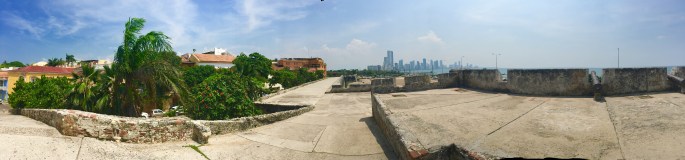
In this battle of cities, Cartagena quickly found itself in pole position. We spent a few days strolling the narrow streets of the old city contained within some 13km of old fortifications. I can see why this is a Unesco world heritage sight. The palette of colours is tropical, from the buildings to the flowers and plants overflowing from balconies, and you are never far away from a plaza or a beautiful church. There is plenty of sunshine and humidity but walking along the coast you can enjoy a cool breeze.


We stay in a beautiful boutique hotel with just 7 rooms on Calle de Mantilla close to Santo Domingo and the cathedral. It is set around an interior courtyard and has a small scenic roof terrace. One day it rained for an hour and I enjoyed listening from the covered balcony. The downpour reminded me of being on a veranda in India. The fruits for breakfast are fantastic especially the sweet papaya.


Sightseeing in Cartagena is just strolling about as you will encounter the main places such as Plaza de Bolivar, a leafy square with palm trees in front of Palacio de la Inquisicion. One evening there was lively music and dance performances in the square.


Walking along the perimeter stone walls you can see the old city within and the new tower blocks outside.
There are so many bars and restaurants in the old town it is hard to pick. I particularly enjoyed seafood casserole and chicken confit at El Santisimo, just off Plaza de Santiago.


How can Bogota compete? Sightseeing here is very different in that you don’t just have one main area to wander around. Many of the upmarket hotels and restaurants are in Zona Rosa district (we stayed in this area) which is about half an hour taxi away from the la Candelaria district where most of the traditional sights are. Furthermore, the city does not feel quite so safe. We experienced a theft at Bogota airport ourselves which is very common according to the airport staff and police. Perhaps this is why so many of the locals pay for plastic wrapping and security belts for their luggage!


That said, Bogota started to grow on me. The Zona Rosa district has fabulous restaurants. Osaka for incredible sweet chilli and mustard seed ceviche and pork ramen, Central Cevicheria for fresh seafood, De Lucca for tasty Italian and great red wine by the glass just to name a few. I also liked the chain BBC (Bogota Beer Company) that can be found across the city.


There are also tasty and far cheaper places to eat in la Candelaria (La Hamburgueseria for tasty burgers and mexican although this is a a chain that be be found elsewhere, San Just for french style tapas, and a random small place we went to that has a set menu of tasty leek soup and fish or chicken for about £6)


The main sights in la Candelaria are around Plaza de Bolivar (yes, another one.) There are some protesters camping in the square albeit in an organised fashion and people selling bird seed to feed the pigeons (as in Trafalgar Square in London or Dam Square in Amersterdam.) You can see several impressive churches and government buildings. I was surprised to see so much wealth on show through the gates of Casa de Narino, the presidential building. This did not stop me from the obligatory tourist photo outside with the guards!

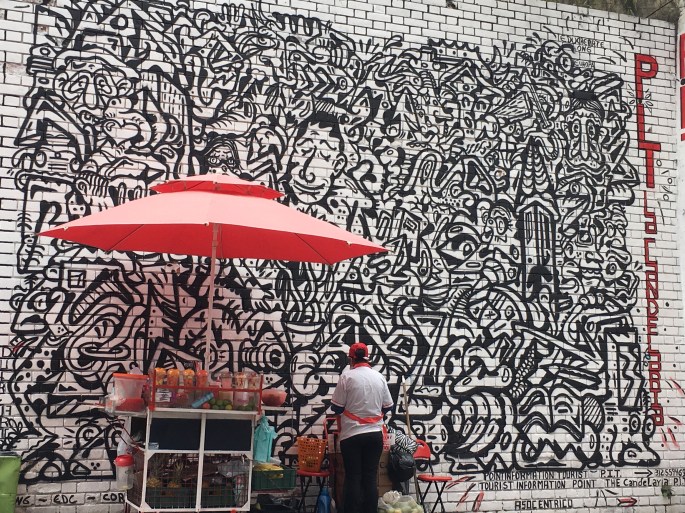
Where Bogota really shone for me was the free street art tour offered by bogotagraffiti.com that commences daily at 10am and 2pm in Parque de los Periodistas. Our guide Ray was Colombian born but grew up in the US. He is passionate about street art and is a gallery owner holding debates on urban art and intellectual property rights and provides us some insight into different street artists and broader historical context.


A collective of 4 artists painted this wall including DJ Lu who did the stencils of war bugs and pineapple grenades (word play in Spanish) “Exploitation ruins lives” is the message on another section with images of a capitalist demon in top hat, a vulture wearing a mining hard hat, and coffee bean coins.


We learn that some of the works refer to “Plan Colombia” when in 2000 the US government paid some $6billion to reduce cocaine supply. Although the money was meant to go towards both training the Colombian military and developmental projects to offer peasants alternatives to coca farming, in reality most of the money went to the military and helicopter dropping of devegatation chemicals that damage other crops and the water supply as the intended coca farm targets.

“False positives” were casualties caught up in the body count methodology used by the military. Uneducated innocent peasants were shot by the military who claimed they were guerillas (often framed in guerilla clothes or as communists.)


The tour lasted 2 and a half hours and enabled us to walk through some of la Candelaria’s most vibrant streets which we may not have ventured to alone. Bogota no longer heavily punishes street artists and this adds another colourful side to the city. Although Cartegena was my favourite city in Colombia, for me it was worth seeing the capital to grasp its multifaceted character.
 neontraveller.com