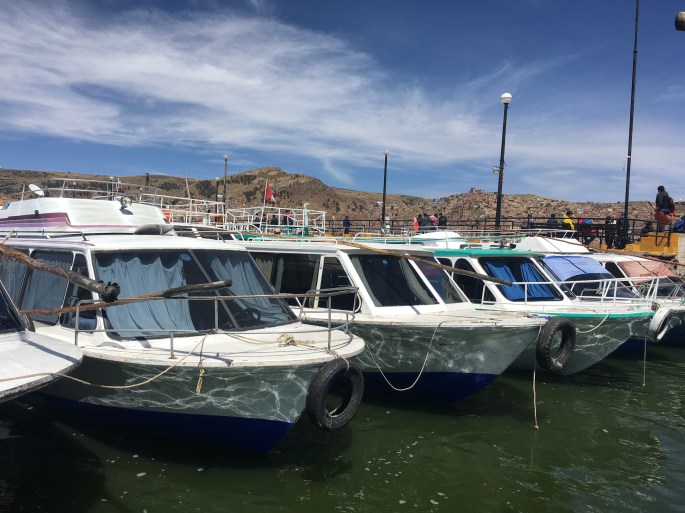
Puno is a town at an altitude of 3830m on the shores of Lake Titicaca. The main industry is mining followed by tourism. The snappy factoid we kept hearing is that Titicaca is the world’s highest navigable lake! That means that large commercial vessels can sail upon its waters.
The Uros floating islands are just 7km east of Puno so were easy to visit in a couple of hours. After our regular pre-5am starts in Cuzco and the Sacred Valley, I was keen for a more relaxed form of tourism. A 9am start sounded good!
Centuries ago the Uros people began their floating life to isolate themselves from the aggressive Collas and Incas. There are now about 2000 inhabitants and roughly 100 individual islands.
Puno is the meeting point of the languages of Quechua, spoken in Cuzco, and Aymara, a pre-Inca language that the Uros people speak. Within the islands, our guide pointed out a small medical centre manned daily by staff from Puno, a football area and told us there were 6 elementary schools.
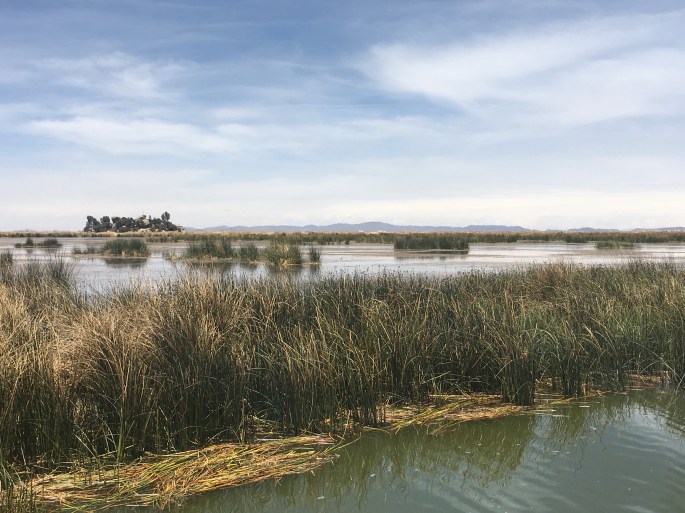
The islands have been created with the buoyant tortora reeds that grown in the shallows of Lake Titicaca. Our cosy group tour of 3 people (myself and an older Portuguese couple) took a boat ride fron the main dock in Puno to the floating islands and were given a demo.
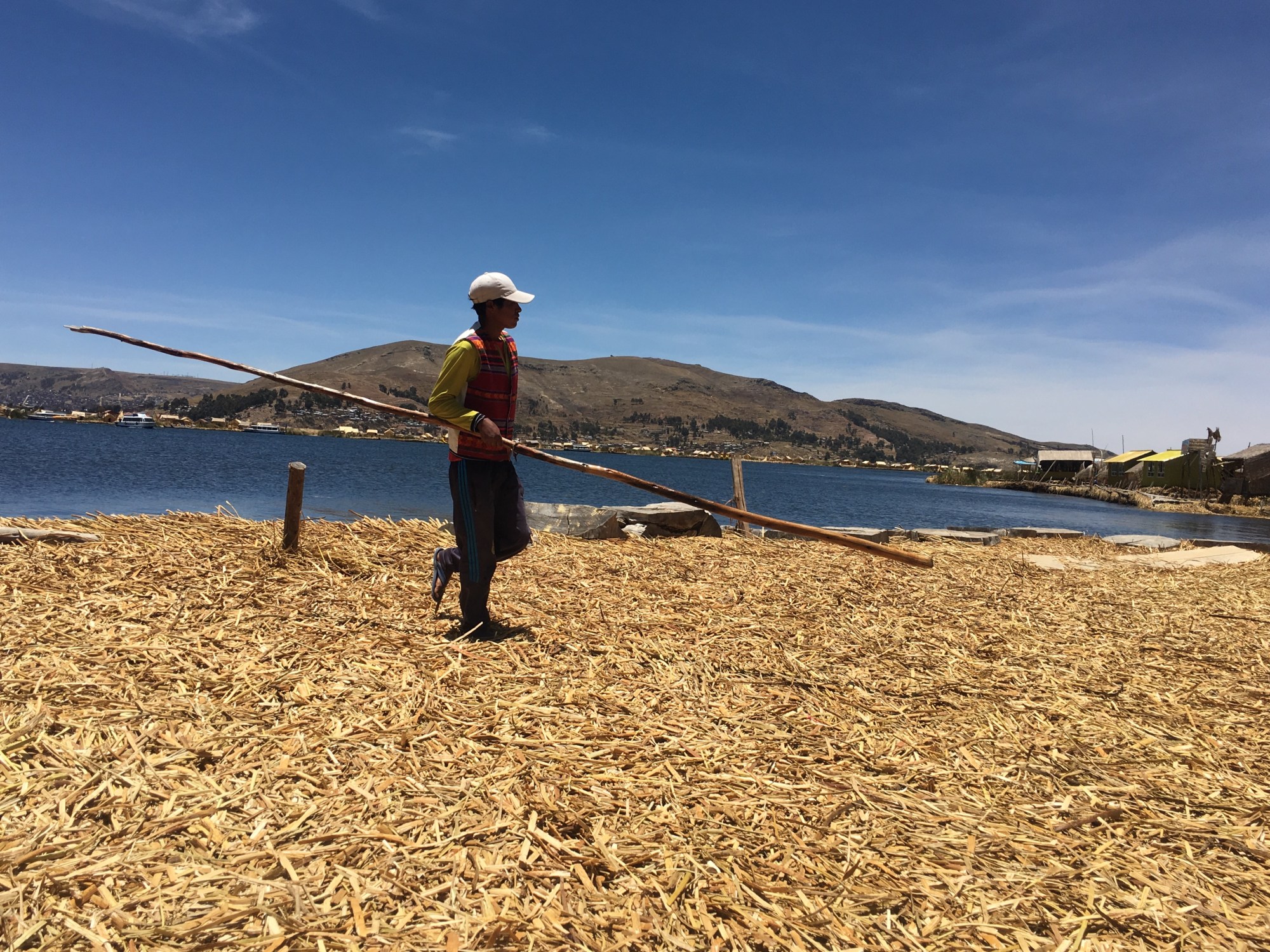
The roots of the reeds are used for the base of the islands and topped up with a scattering of the green part of the reeds which dries out to become yellow. The top layer is regularly replenished. I was amazed by how bouncy and springy the island felt.


We also learned the local people eat the white lower part of the reed that helps to clean their teeth, and parts of the plant are used as plasters and medicine.
The only local fish are the small choca. Kingfish were introduced to Lake Titicaca from Argentina and trout were brought over from Canada.


On the first island we visited, Flamenco, a smiling local women invited me to her small reed house.Before I knew it she started dressing me up in the local clothes. This was quite a bizarre experience as she and her daughter started putting braids in my hair and I had not asked for any of this. But I went with the flow and saw the Portuguese couple were getting the same dressing-up treatment. This made for some touristy but fun pictures.


The ladies did not accept money for the dressing up service, but then showed us the handicrafts that they were selling. As I did not want any, I gave them 30 soles (£7.50). The local lady kindly gave me a bracelet as she would not accept the money for nothing. I realised later on that the bracelet was made of bright red Huayruro seeds that are meant to attract good luck, fortune and love and protect against envy. I now really like the bracelet that suits my travel schedule!
The family were very sweet and the kids were occupied with their colouring books in the small house.


After the locals of the first island gave us a sing-song send off including ‘row row row your boat’,we boarded a beautiful traditional reed rowing boat to the next island. The intricate double puma head design showed incredible craftmanship.


The second island called Utama was a more commercial place to buy crafts and drinks.
I loved being on a boat out on the lake under the bright blue skies. The locals we met were really friendly. The Lonely Planet guidebook warned that some local people do not appreciate tourists interrupting their lives but the islands that I visited were geared up for tourists.


After the tour, I met my friend Adam in Puno’s main square and we had lunch at Mojsa restaurant, Aymara for delicious. The area near the port has a colourful beach town feel to it.


Back at the hotel, we enjoyed the lake views and another hotel dinner with good red wine! The wifi was not strong enough for any blogging hence the backlog!
I would have been happy to spend more time at the lake visiting some of the main (non-floating) islands. However, the floating islands were the most unusual and definitely worth seeing if you only have a short time in Puno. We were also lucky enough to have pretty constant views of the lake from our hotel (Taypikalo Lago) and taxi rides to and from Puno.
 neontraveller.com